Kane County Connects
Engaged Citizens. Involved Communities. Open Government.
Menu
  • Census 2020: Kane County, IL

Subscribe to Kane County Connects E-Newsletter!

Select list(s) to subscribe to

Subscribe to Blog via Email

Enter your email address to subscribe to this blog and receive notifications of new posts by email.

Join 11.4K other subscribers

Login

  • Log in
  • Entries feed
  • Comments feed
  • WordPress.org

Blog Stats

  • 12,662,469 hits
Browse: Home   /   2014   /   July   /   Mike Donahue: Solar Power ‘a No-Brainer’— for Kane County and at Home
Mike Donahue: Solar Power 'a No-Brainer'— for Kane County and at Home

Mike Donahue: Solar Power ‘a No-Brainer’— for Kane County and at Home
kanecountyconnects / July 15, 2014 / Comments Off on Mike Donahue: Solar Power ‘a No-Brainer’— for Kane County and at Home / Environment, Government, Kane County Connects, People

Mike Donahue mug Solar power image 1 Solar power image 2Screen Shot 2014-07-15 at 8.58.24 AM

Kane County Board member Mike Donahue is passionate about energy.

Professionally, he is the founder of Midwest Wind Energy, LLC, a company that facilitated the use of wind turbines in rural areas and worked with communities and local governments to receive the necessary permits for their construction, according to an article on the Medill Reports Chicago website.

Personally, he takes to heart the lessons he’s learned over time about the benefits and practical use of renewable energy. An excellent example is his home in Geneva, where he has installed a 6.5 kw solar system cost of about $24,000 USD.

“My bills are zero,” he said over coffee last week. “It just sits there and produces electricity, day after day after day after day.”

The solar-panel investment will pay for itself in less than eight years, he said, and in fact is producing more energy than his home can use. So the excess energy his home’s solar panels collect goes back to the community — in this case to the city of Geneva.

In states such as Wisconsin, residents who use solar energy in their homes actually get paid for the excess energy they produce. So if Donahue’s home were Up North, he said, he’d be getting a regular check in the mail.

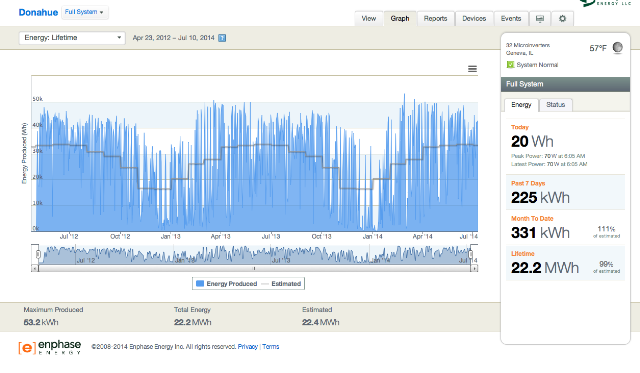
Instead, Donahue’s reward is the kick he gets out of going online and looking at the numbers. He can tune in to to a website and see, in real time, how much energy each panel in his home is producing. He can look at the history and identify the peak days — the highest producer, surprisingly, was a cold clear day in the midst of the polar vortex this past winter — and how much energy his home is producing on behalf of itself and the community.

Donahue says there’s a sort of “mental block” about using solar energy. A lot of people have the misconception, or outdated perception, that the technology is expensive or that solar energy panels are difficult to maintain or replace. In fact, Donahue says, solar energy is easy.

“It’s set-it-and-forget-it technology,” he said. “Maintenance is virtually free.”

That’s why, two years ago, Donahue suggested at an Energy and Environment Committee meeting that the county should consider installing some solar units at the Judicial Center, whether at the courthouse or Juvenile Justice Center or one of the other buildings on the campus. Since then, Donahue said the county has completed a highly-detailed energy audit so that “we know down to the last kilowatt hour how much energy we’re using and how much we’re paying for it.”

It’s also why Donahue is advocating for the county to look at solar energy in future iterations of the Judicial Center and at other county buildings.

“It’s really a no-brainer,” he said. “The point I have here is, for any entity, whether it’s a community college or university, business or government institutions of all types — really, any facility that’s going to be around more than a few years — it really doesn’t make sense to purchase energy from a local supplier. It will be cheaper. It’s not even a question, it’s a mathematical fact.”

Donahue is retiring from government service when his term ends this year. He says that among his goals and contributions to county government during that time, his efforts to see some of the recreational promise of the Settler’s Hill Landfill site come to fruition are probably at the top of his list.

But he hopes, too, that he will at least have planted the seed for other, future policy-makers to consider: the potential cost savings of solar energy.

“Maybe this is one more thing I can do,” he said.

Share this:

  • Email a link to a friend (Opens in new window) Email
  • Share on Facebook (Opens in new window) Facebook
  • Print (Opens in new window) Print
  • Share on X (Opens in new window) X
Tags: Government, Kane County, Mike Donahue, Solar Energy
Mike Donahue: Solar Power 'a No-Brainer'— for Kane County and at Home

Mike Donahue: Solar Power ‘a No-Brainer’— for Kane County and at Home

kanecountyconnects / July 15, 2014 / Comments Off on Mike Donahue: Solar Power ‘a No-Brainer’— for Kane County and at Home / Environment, Government, Kane County Connects, People

Mike Donahue mug Solar power image 1 Solar power image 2Screen Shot 2014-07-15 at 8.58.24 AM

Kane County Board member Mike Donahue is passionate about energy.

Professionally, he is the founder of Midwest Wind Energy, LLC, a company that facilitated the use of wind turbines in rural areas and worked with communities and local governments to receive the necessary permits for their construction, according to an article on the Medill Reports Chicago website.

Personally, he takes to heart the lessons he’s learned over time about the benefits and practical use of renewable energy. An excellent example is his home in Geneva, where he has installed solar panels at a cost of about $24,000.

“My bills are zero,” he said over coffee last week. “It just sits there and produces electricity, day after day after day after day.”

The solar-panel investment will pay for itself in less than eight years, he said, and in fact is producing more energy than his home can use. So the excess energy his home’s solar panels collect goes back to the community — in this case to the city of Geneva.

In states such as Wisconsin, residents who use solar energy in their homes actually get paid for the excess energy they produce. So if Donahue’s home were Up North, he said, he’d be getting a regular check in the mail.

Instead, Donahue’s reward is the kick he gets out of going online and looking at the numbers. He can tune in to to a website and see, in real time, how much energy each panel in his home is producing. He can look at the history and identify the peak days — the highest producer, surprisingly, was a cold clear day in the midst of the polar vortex this past winter — and how much energy his home is producing on behalf of itself and the community.

Donahue says there’s a sort of “mental block” about using solar energy. A lot of people have the misconception, or outdated perception, that the technology is expensive or that solar energy panels are difficult to maintain or replace. In fact, Donahue says, solar energy is easy.

“It’s set-it-and-forget-it technology,” he said. “Maintenance is virtually free.”

That’s why, two years ago, Donahue suggested at an Energy and Environment Committee meeting that the county should consider installing some solar units at the Judicial Center, whether at the courthouse or Juvenile Justice Center or one of the other buildings on the campus. Since then, Donahue said the county has completed a highly-detailed energy audit so that “we know down to the last kilowatt hour how much energy we’re using and how much we’re paying for it.”

It’s also why Donahue is advocating for the county to look at solar energy in future iterations of the Judicial Center and at other county buildings.

“It’s really a no-brainer,” he said. “The point I have here is, for any entity, whether it’s a community college or university, business or government institutions of all types — really, any facility that’s going to be around more than a few years — it really doesn’t make sense to purchase energy from a local supplier. It will be cheaper. It’s not even a question, it’s a mathematical fact.”

Donahue is retiring from government service when his term ends this year. He says that among his goals and contributions to county government during that time, his efforts to see some of the recreational promise of the Settler’s Hill Landfill site come to fruition are probably at the top of his list.

But he hopes, too, that he will at least have planted the seed for other, future policy-makers to consider: the potential cost savings of solar energy.

“Maybe this is one more thing I can do,” he said.

Share this:

  • Email a link to a friend (Opens in new window) Email
  • Share on Facebook (Opens in new window) Facebook
  • Print (Opens in new window) Print
  • Share on X (Opens in new window) X
Tags: Government, Kane County, Mike Donahue, Solar Energy
← Mike Donahue: Solar Power ‘a No-Brainer’— for Kane County and at Home
Blackberry Township Assessments Published Thursday, July 17 →

http://retired.kanecountyconnects.com/census-2020-kane-county-il/

TEXT TO SUBSCRIBE!

Kane County Connects Facebook

Kane County Connects Facebook

Kane County Counts!

Kane County Counts!

Why Kane?

Why Kane?

Kane County OpenGov

OpenGov

Connect With Kane County Connects!

KCC Subscribe

Subscribe to KCC's E-Newsletter and receive all the most recent updates and news!

Copyright © 2026

Powered by Oxygen Theme.


Loading Comments...